
Lessons Americans can learn from Gazans during the government shutdown
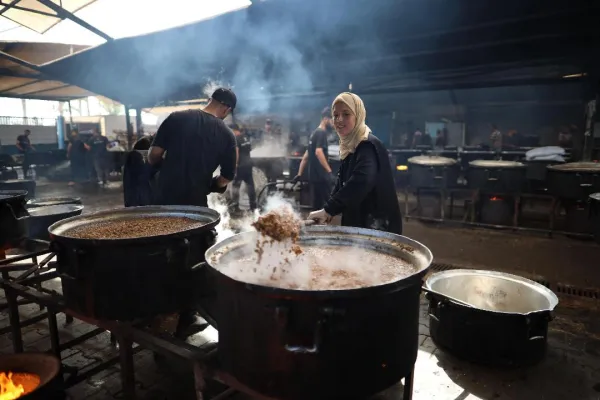
America is under shutdown for the last 31 days and Gaza Strip has been under siege for the last 19 years. So, how did Gazans manage to survive and what lesson can American learn from Gazans during the government shutdown to make ends meet?
First of all, with almost no aid allowed in and food prices soaring, parents and children in Gaza are risking their lives to get even small amounts of food or safe water. Many are walking for hours, waiting in crowds, or dodging dangerous strikes and fire – only to return empty-handed.
However, Gazans have adapted to extreme food shortages by relying on a few meals a day, often skipping meals to feed their children. The UN World Food Program (WFP) reports that most families in Gaza survive on one meal a day, with one-third going entire days without eating. The meals available are often thin broths, lentils, rice, or a combination of herbs and olive oil known as "duqqa."
Since October 1, Congress failed to pass appropriations bills, leading to a lapse in funding for non-essential government operations. This situation can significantly disrupt employment and unemployment across the country.
"I witnessed evil": Anti-LGBTQ+ hate groups support Ohio’s public drag ban

This article first appeared on the Buckeye Flame.
Ohio’s proposed drag ban received its second hearing Wednesday before members of the House Judiciary Committee.
The hearing featured public testimony in support of the bill from two anti-LGBTQ+ hate groups: Mission America and the Columbus-based Center for Christian Virtue (CCV), which is a primary driver of anti-LGBTQ+ legislation at the Ohio Statehouse.
Julialynne Walker to be honored at Free Press Awards Event

Versión en español a continuación
Celebrating our 55th year, the Columbus Free Press will honor five outstanding community activists and a community organization at our November 2025 Salon and Awards event on Saturday, November 8 from 1:30-4:30pm at the First Unitarian Universalist Church, 93 W. Weisheimer Road. One honoree for the Free Press 2025 Outstanding Community Activist is Julialynne Walker.
New York Needs a Real Witchdoctor
I was born and grew up in New York City. I rode the subway to school way, way downtown. School buses were for sissies. I was a typical New York City tough kid. For years I lived with my mother in run-down old hotels owned by my father who was clawing his way up from a modest life on the Lower East Side.
The idea of ‘affordable housing,’ a shibboleth now popular with the general public, barely existed. On those distant days, save on the wilder shores of leftwing unionism, you worked hard as hell to pay your rent or slept on the roof or in the park.
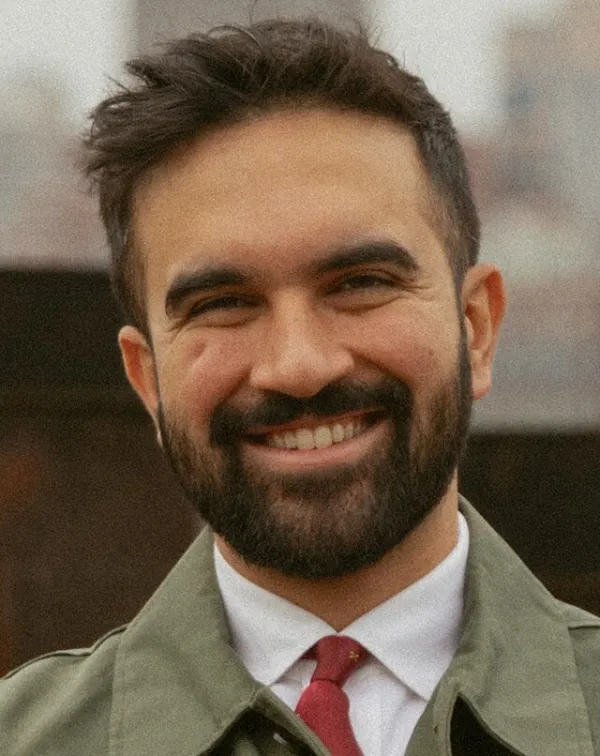
In 1991, Zohran Mamdani appeared in the big city out of nowhere. Mamdani had won an election as an assemblyman in New York’s 36th District. He had been born in Uganda and, like many ethnic Indians, fled the rampages of despot Idi Amin. Uganda’s Asians have produced a large number of highly talented people, among them the young Mamdani. Astoundingly, he is a proud Muslim in a city dominated by pro-Israel, wealthy Jewish residents, Latin Americans and Haitians.
Beyond the 'Unbreakable Bond': Is the US Reclaiming the Wheel from a Self-Destructive Israel?

Has Donald Trump's sharp rebuke of Israel in his October 23 Time Magazine interview fundamentally changed the calculus in the Middle East? His comments immediately sparked two opposing views: for some, his position represents the clear demarcation of a genuine shift in US foreign policy; for others, it is nothing more than a political ploy designed to claw back credibility lost by the US during two years of Israeli genocide in Gaza.
Regarding the end of the recent Gaza genocide, Trump claimed Israeli Prime Minister Benjamin Netanyahu “had to stop because the world was going to stop him,” adding, “you know, I could see what was happening ... And Israel was becoming very unpopular.” With these words, Trump signaled his view that the systematic extermination of Palestinians in Gaza had pushed Israel to an inevitable point of isolation that even the US could no longer indefinitely hold back.
Trump’s “Ballroom” to be a Homeless Shelter/Soup Kitchen…Rural Democracy; CBS/Fox
Hour 1
We begin with the obvious question: Does Trump have dementia?
Of the past six presidents, 3.5 have been incompetent.
Our resident expert DR. NANCY NIPARKO concurs on Reagan, a bit on W but less so on Biden & moreso on Trump.
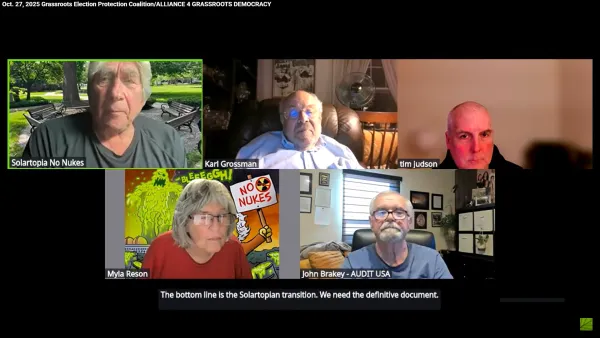
Co-host MYLA RESON challenges the idea that Trump’s murders in the Caribbean are rooted in dementia rather than corporate greed.
We note that MAGA commentator Tomi Lahren is screaming at Trump for bailing out the Argentine cattle industry while destroying the one here in the US.
Co-host MIKE HERSH then introduces ANTHONY FLACCOVENTO who explains to us his innovative Rural New Deal.
From the rural woodlands of central California JULIE LEVINE warns us of lethal alienation.
We then welcome legendary network news veteran DAVID SALTMAN to offer alternatives to the billionaire-dominated “legacy” media that now all sounds like Fox.
Hour 2
The World-Changing Transition from Fossil-Nukes to Solartopia is Happening Now
Letter to Editor: Columbus needs a change
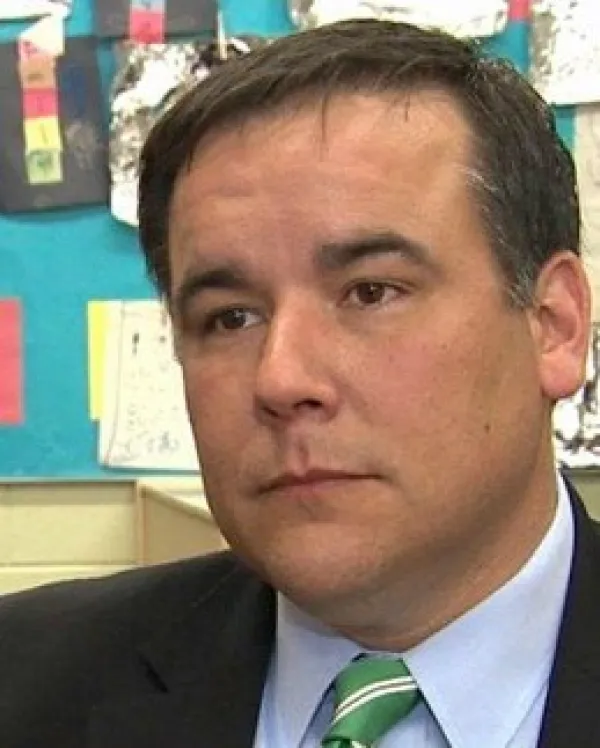
These comments were always intended for private conversations but Columbus Mayor Andrew Ginther and Columbus City Council President Shannon Hardin continually ignore us so, now I am compelled to speak publicly. Ginther served on the Columbus School Board six years before his appointment to City Council. Then he was elected Mayor in 2016. Hardin was appointed to Council in 2014 and has been President since 2018.
Here is an abbreviated recap of the Ginther-Hardin legacy. Columbus ranked as the second most economically segregated major US city in 2015. In 2022, the JPMorgan Chase report found racial inequities cost Columbus’ economy $10 billion annually. A 2024 report said Columbus is growing by leaps and bounds but is 700 years behind in racial equality.
In July 2025, JD Vance said Columbus is lawless. In September, Columbus Police Lieutenant and Fraternal Order of Police (FOP) President Brian Steel had his SUV with Marine Corp plates stolen from his driveway. Last week, NBC4 reported 182 cities were ranked and Columbus placed at No. 159, making it the 24th most unsafe city. It ranked even lower at No. 164 for home and community safety.
Honor Heer to Serve with us at the Free Press Annual Awards Event
Versión en español a continuación
Celebrating our 55th year, the Columbus Free Press will honor five outstanding community activists and a community organization at our November 2025 Salon and Awards event on Saturday, November 8 from 1:30-4:30pm at the First Unitarian Universalist Church, 93 W. Weisheimer Road. Our honoree for the Free Press 2025 Outstanding Community Organization is Heer to Serve.
Heer to Serve advocates for those who are unsheltered and facing housing insecurity with a person centered approach, providing emergency and necessary supplies and support to those on the far south side of Columbus. Heer to Serve volunteers work to meet their basic needs through tangible items, social support, and programing.
The residents of Heer Park guide their mission because they believe showing up for those in need is just as important as empowering others, uplifting them through their struggles, and acknowledging the expertise of those with lived experience.
APPLICATIONS CLOSING SOON: Become an Abortion Forward Board Member

With just a few days until applications close on October 31st, I wanted to reach out and personally encourage you to apply to the Abortion Forward and Abortion Forward Alliance board.
Reel Time with Richard: Painful memories of an eradicated past
My community is getting ready for the annual Columbus Jewish Film Festival, but a local theater is beating it to the punch with one of the most powerful Holocaust-related documentaries you’re likely to see this year.
Among Neighbors, directed by Yoav Potash (Crime After Crime), is about the tragic and lasting effects World War II had on the town of Gniewoszów, Poland. The film is at once a history lesson, a tale of survival and a portrait of humanity at its best and its absolute worst.
It’s also a mystery, one whose solution isn’t provided until the film’s final moments.
Because the documentary does so much, and because Potash waits so long to connect seemingly disparate parts, it sometimes comes off as disjointed. But the dramatic end justifies the director’s suspense-building means, and the film is never less than compelling along the way.
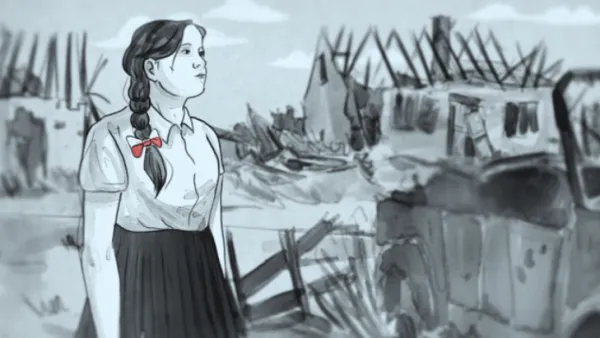
Using a combination of contemporary interviews, archival footage and eloquent hand-drawn animation, Potash introduces us to Gniewoszów both past and present.